April 11, 2026
What a campaign taught me about community — and why I co-founded Bird's Eye Impact
Author
The civic landscape shaping a nonprofit's funding, partnerships, and reach is rarely visible from the inside.
Bird's Eye Impact makes it visible.
I didn't set out to start an organization. I set out to offer a different kind of public witness. What I found along the way changed everything.
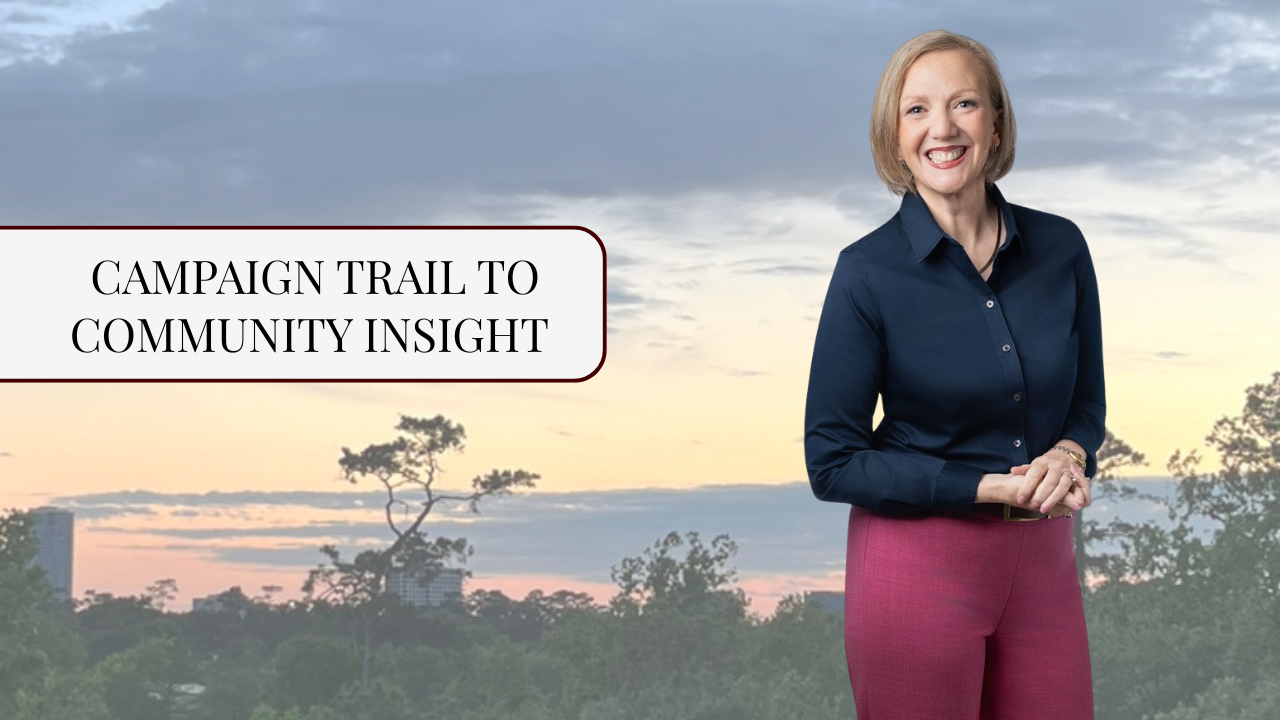
I am an ordained minister. For years, my work lived inside faith communities — guiding, listening, walking alongside people through the ordinary and extraordinary moments of their lives. That work grounded me in something I have come to believe is foundational to everything else: relationships, and the shared humanity that makes them possible.
But when I watched legislation pass that excluded and targeted vulnerable communities — justified, explicitly, in the name of faith — I felt I could not stay only in that lane. My opponent had co-authored that legislation. I believed someone needed to stand and offer a different witness. One rooted in dignity, justice, and a theology that affirms the full humanity of every person.
So I stepped into the public arena and ran for office.
I did not win. But what I gained from that campaign — what it forced me to see — has shaped everything I have done since.
Beyond the walls of the church
Campaigning is a particular kind of education. There is no classroom for it, no curriculum, no institution that can replicate what happens when you show up — repeatedly, humbly, as a candidate — to rooms and neighborhoods and conversations you would not otherwise enter.
I attended Chamber of Commerce meetings. I participated across all four local school board districts in our area. I block-walked in neighborhoods I had never set foot in before. I sat across from people who disagreed with me deeply, and I stayed, and I listened.
I met neighbors across the full political spectrum. Some energized. Some exhausted. Young people ready to create change — and others, just as young, already disillusioned by a political climate that had given them little reason for optimism.
Community is not built on uniformity. It is not built on agreement. It is built on shared humanity and a willingness to truly see one another.
That conviction became my anchor. And it kept me in rooms long after it would have been easier to leave.
The strength and the strain
What I encountered in Greater Houston was not a single story. It was two stories running alongside each other, inseparable.
I saw extraordinary generosity. Nonprofits working tirelessly, often beyond their capacity. Faith communities stepping in where systems had stepped back. I remember a local mosque offering free healthcare clinics every single week — quietly, consistently, meeting urgent need without waiting for recognition or permission. It was one of the most powerful things I witnessed during that entire campaign.
And at the same time, I saw the strain. Fragmented systems. Limited coordination between organizations doing overlapping, sometimes duplicative work. Widening disparities in a region with no centralized civic structure — where community boundaries overlap, where residents are often split across multiple jurisdictions, and where that fragmentation quietly shapes outcomes in ways most people never fully see or name.
Both realities were true. Both demanded attention.
The problem is not a lack of effort
The more I listened, the more clearly I saw something that I have not been able to look away from since.
No single elected official, nonprofit, faith community, business, or donor can solve these challenges alone. That is not a failure of will. The effort is real. The care is real. The commitment, across this region, is genuinely extraordinary.
The issue is not a lack of effort. The issue is a lack of shared visibility.
Organizations are doing meaningful work — and doing it without a clear picture of who else is serving the same communities, where the real gaps exist, or how the civic systems around them are shaping and sometimes constraining what is possible. Without that shared understanding, even strong, well-resourced efforts remain disconnected from one another.
And disconnected effort, however sincere, rarely produces the change communities actually need.
Why we built Bird's Eye Impact
That realization stayed with me. It grew. And it ultimately became the foundation for co-founding Bird's Eye Impact.
The question I kept returning to was simple: what would change if we could all see the full ecosystem in which we operate? What becomes possible when that visibility is shared — not held by one organization or one leader, but accessible to the whole community?
What we do: Through strategic mapping, analysis, and collaboration design, Bird's Eye Impact helps nonprofits and civic leaders across Greater Houston understand their civic landscape — who is serving, where gaps exist, and how resources and relationships can align for greater, more coordinated impact.
We work to move communities from fragmented effort toward informed, coordinated action — so that all neighbors have the opportunity to thrive. Not just those who happen to live on the right side of a jurisdictional line, or whose needs happen to be served by an organization that is already well-resourced and well-connected.
Why this moment matters
Resources are tightening. Needs are increasing. Systems are under strain in ways that were already visible before recent years made them more acute.
In that environment, clarity is not optional. Civic awareness — knowing your landscape, understanding how the ecosystem around you actually functions — is a strategic advantage. It shapes how organizations pursue funding, how partnerships are built, and how quickly communities can respond when something goes wrong or an opportunity emerges.
When we understand the full landscape, we can begin to move from fragmentation toward alignment. From isolated effort toward shared impact.
What the campaign gave me
My campaign did not end with a seat. It did not lead to a title or a position of formal authority.
But it changed how I understand what leadership actually requires. Leadership is not only about position. It is about perspective — and about the willingness to step beyond what is familiar, to show up in rooms that are uncomfortable, and to truly see your community as it is, not as you imagine it to be.
I stepped outside the walls I knew. I listened across difference. I saw both the extraordinary strength and the real strain of the place I call home. And I came back with a clearer sense of what was needed and what I could do about it.
That is what Bird's Eye Impact is built on.
And it all started with a decision to step outside, to listen, and to see.