November 24, 2026
Does Your Nonprofit Know Its School Board?
Author
The civic landscape shaping a nonprofit's funding, partnerships, and reach is rarely visible from the inside.
Bird's Eye Impact makes it visible.
A child walks into a classroom carrying the experiences of their household with them. If their parents are struggling to find affordable housing, secure meaningful employment, access healthcare, or put food on the table, those experiences can shape the child's ability to learn that day.
Throughout our communities, nonprofits are working to address those very needs. They are helping parents find employment, providing food for families, connecting households to healthcare resources, and helping families secure stable housing.
Schools and nonprofits are often serving the very same families. Imagine the possibilities if more of our nonprofits developed intentional relationships with the school boards and school district leaders serving their communities.
At
Bird's Eye Impact, we believe these relationships represent a significant opportunity for nonprofits to expand their community impact.
Understanding who governs our schools
Did you know that there are 61 separate governing bodies overseeing public school campuses in Harris County?
Together, they govern 1,145 campuses educating 875,229 students.
- 19 school districts and the Harris County Department of Education oversee 978 campuses serving 784,584 students.
- 41 open-enrollment charter operators oversee 167 campuses serving 90,645 students.
Each governing body has its own leadership, priorities, and responsibilities. Depending on where the families your nonprofit serves live and attend school, you may have opportunities to develop relationships with several of these governing bodies.
This is one of the reasons Bird's Eye Impact includes Schools and Colleges in the Ground View of our Atlas. We identify the school districts and community college districts serving a nonprofit's community, along with their trustees and leadership.
Knowing who governs and leads these educational institutions helps nonprofits identify where to begin building relationships.
What this looks like in one community
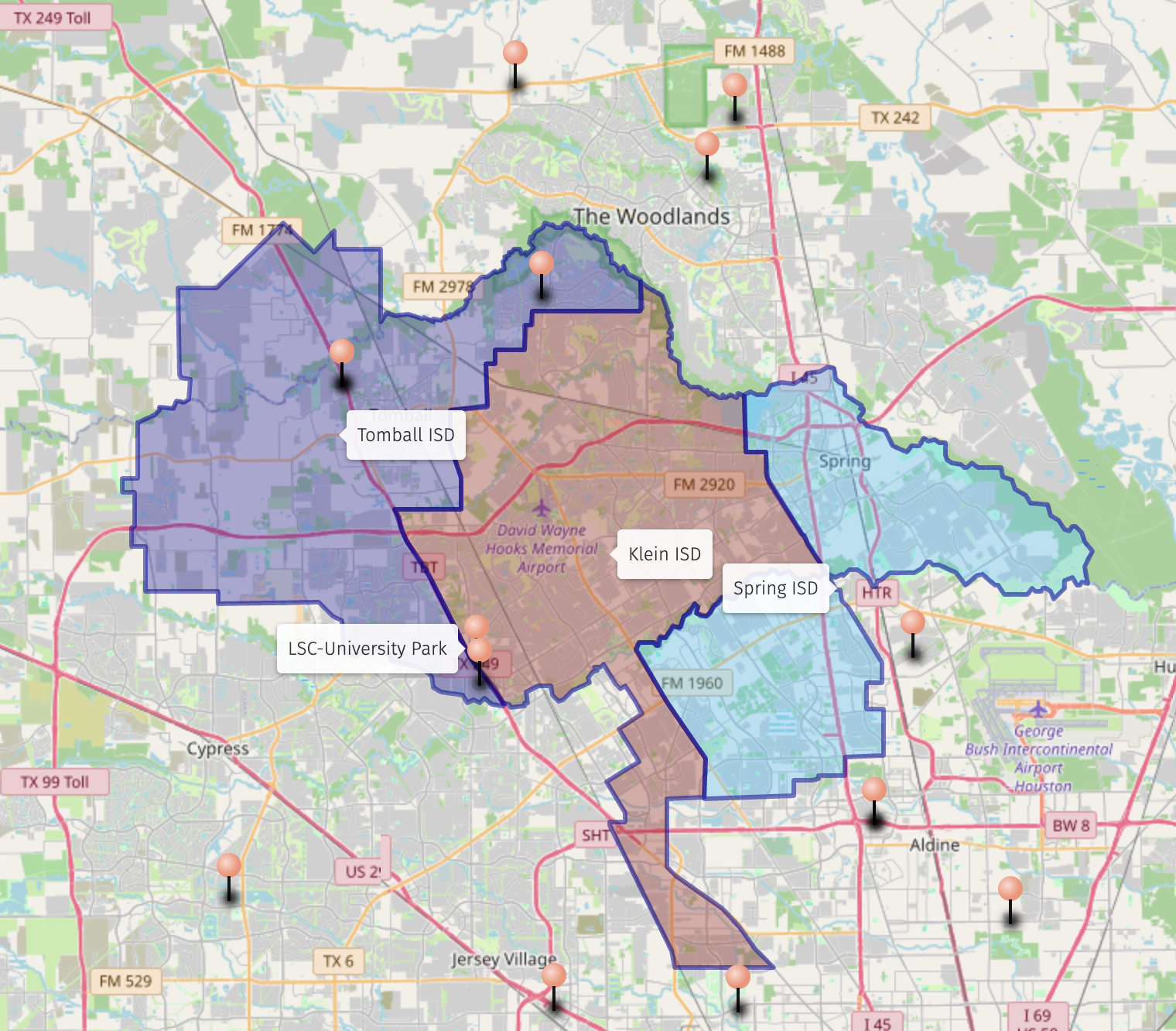
In our work within a four-zip-code corridor in north Harris County, we identified three separate public school districts serving that community. Each district has its own superintendent and elected board of seven trustees. All three school districts sit within one community college district.
Two families receiving services from the same nonprofit may live just a few streets away from one another, yet their children may attend schools governed by entirely different school boards.
For a nonprofit providing after-school programs, food assistance, or mental health services, understanding those district boundaries can help identify potential partnerships across all three school districts.
For a nonprofit helping adults secure employment or increase their household income, developing a relationship with the community college district could open opportunities for workforce training, professional certifications, and continuing education.
Understanding the educational landscape of your community can help you identify opportunities to strengthen the work your nonprofit is already doing.
Building the relationship
Think about the resources your nonprofit provides and how those resources might complement the work of your local schools.
A food assistance nonprofit might learn from school district personnel where families are experiencing gaps in food access. A housing nonprofit might connect with district staff who support students experiencing housing instability. A healthcare nonprofit might discover opportunities to connect families with affordable healthcare services through school district family engagement programs.
School board trustees can offer a valuable perspective on the broader needs and priorities of the district. Superintendents and district staff can help identify where a nonprofit's services might complement existing programs and where opportunities for collaboration exist.
These possibilities begin with getting to know one another.
One of the most valuable questions a nonprofit leader could ask a school district leader is a simple one: What are the needs you are seeing among the families in your district, and how might our nonprofit help?
The answer may reveal opportunities your nonprofit has never considered.
Three simple ways to begin
As you approach the end of the year and begin planning for 2027, consider taking one of these three steps.
1. Attend a school board meeting.
Find out when your local school board meets and put a meeting on your calendar. Review the agenda beforehand and listen to the conversations about students, families, and the district's priorities.
Introduce yourself to a trustee or district staff member when an appropriate opportunity arises. Follow up with a short email introducing your nonprofit and expressing your interest in learning more about the district's work.
2. Invite school district leaders to visit your nonprofit.
Extend an invitation to a superintendent, school board trustee, or relevant district staff member to visit your nonprofit. Give them an opportunity to see your programs, learn about the families you serve, and understand the resources you provide in their community.
Use part of that visit to learn more about the needs they are seeing among their students and families.
3. Begin sharing information with one another.
Invite school district leaders to receive your nonprofit's newsletter and learn about your programs, community events, and available resources.
Subscribe to the school district's newsletter as well. Follow its announcements and become familiar with its priorities and initiatives. Over time, you may begin to recognize opportunities to support one another's work.
Any of these steps can be taken by a nonprofit staff member or a member of your nonprofit's board working in coordination with staff leadership. Each offers a manageable way to begin developing a relationship that could eventually lead to meaningful partnerships.
Before the year ends, identify which school districts and community college districts serve the families in your community. Choose one educational institution and one person on your team to initiate a relationship.
Start with one introduction, one conversation, or one invitation.
You may discover that one of your nonprofit's most valuable future partners has been serving the same families in your community all along.